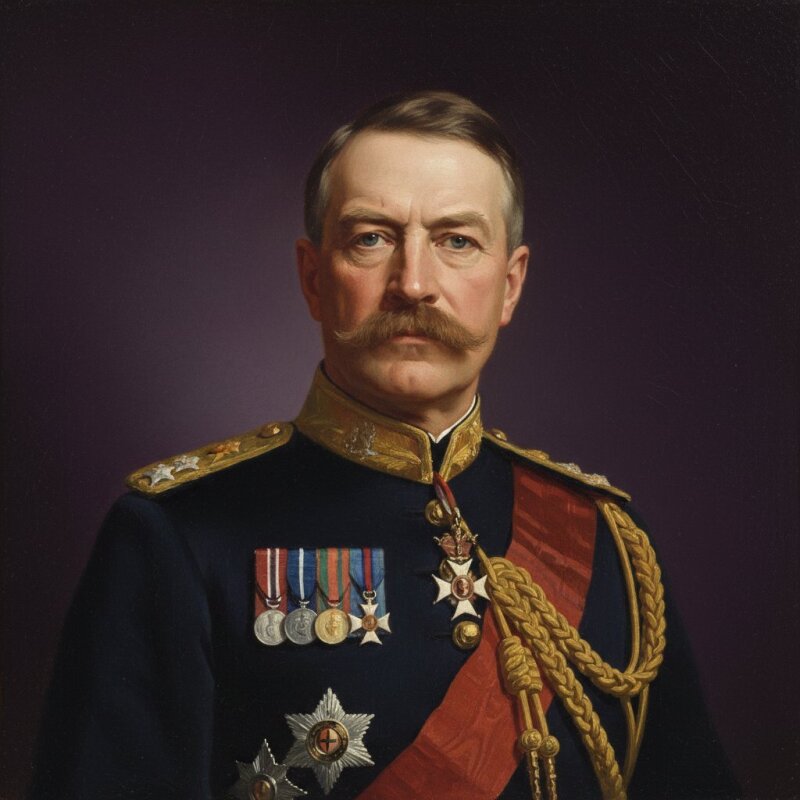
Lord Kitchener
“I measured deserts in miles and wars in men; the sums never came out clean.”
I was commissioned into the Royal Engineers and taught to count what others only guessed—gradients, distances, supply. In the eastern Mediterranean I surveyed, learned Arabic, and then took command in Egypt. As Sirdar of the Anglo‑Egyptian Army I was ordered to reconquer the Sudan. We laid a military railway across the desert, moved guns and grain by timetable, and at Omdurman in 1898 disciplined infantry, artillery, and machine‑gun fire broke the Mahdist army. That same year at Fashoda I kept my temper, and the Empire kept its peace with France.
In South Africa I succeeded Lord Roberts and closed a mobile war by fixing it in place. Blockhouses, barbed wire, and columns cut the veld into districts; scorched earth and camps for civilians followed. It shortened the fighting and ended with the Treaty of Vereeniging in 1902. It also brought hardship I could not ignore. Decisions made in war are seldom tidy.
As Commander‑in‑Chief in India, 1905 to 1909, I trimmed a tangle of commands, strengthened staff work and training, and prepared for both the frontier and a continental test. My dispute with the Viceroy, Lord Curzon, was plain enough: soldiers should answer for soldiering. I later served as British Agent and Consul‑General in Egypt.
In 1914, as Secretary of State for War, I told the Cabinet the struggle would be long and exacting. We raised a citizen army by the hundred‑thousand, and found shells and rifles wanting often enough. Politics bit as hard as logistics. In June 1916 I sailed for Russia aboard HMS Hampshire; a mine off the Orkneys ended the voyage—and my service.
Related characters
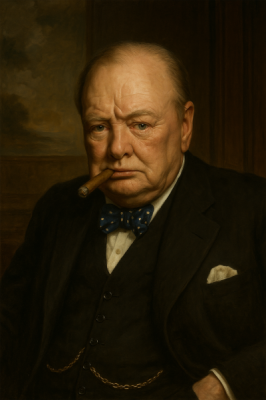
Winston Churchill
I sent men to Gallipoli—then put on a tin hat and went to the trenches to answer for it.
Start the conversation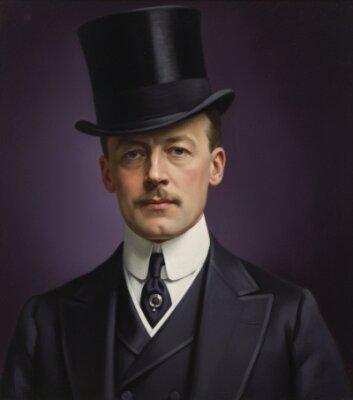
Leopold Berchtold
I served a cautious court—and sent the note that made caution impossible.
Start the conversation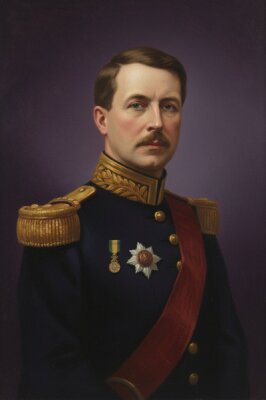
Albert I of Belgium
I stayed when others urged me to sail, and I let Belgian fields be drowned so the country would not be taken.
Start the conversation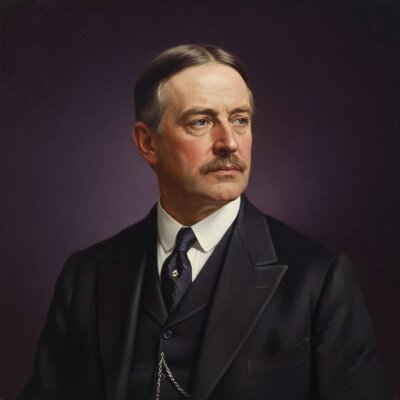
David Lloyd George
I humbled the Lords and outfoxed generals, yet shook Hitler’s hand in 1936.
Start the conversation