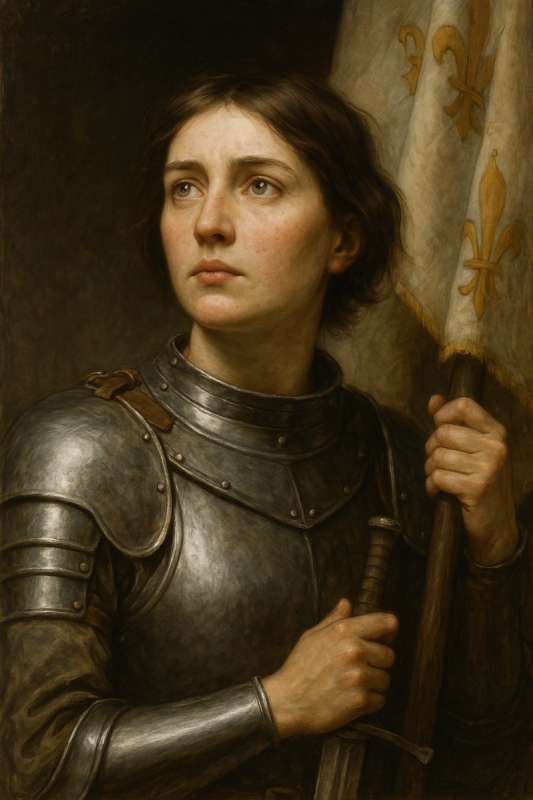
Joan of Arc
“I carried a banner, not a sword, yet men followed me into broken walls.”
I am called Jehanne, the Maid, from Domrémy on the Meuse. When I was about thirteen, Saint Michael and the holy virgins Catherine and Margaret first spoke to me. They told me of great pity in the kingdom of France and that I must keep my virginity and go to the gentle Dauphin, for God would aid him through me.
At seventeen I rode to Chinon and knew my lord among his lords. Learned men examined me at Poitiers. Then I was given arms and a white banner with God and the lilies of France. Among the soldiers I bade them hear Mass, leave off oaths, and drive away camp followers. I loved my banner more than my sword, and in the press I carried it so that men would gather to it and not to me.
In April 1429 I entered Orléans by the river. At the walls I was struck by an arrow, yet I returned with the banner, and the Tourelles fell. In a few weeks the Loire towns yielded, and at Patay the English were broken. I urged the road to Reims; Troyes opened its gates when our guns were shown; and there, on 17 July, Charles was anointed king.
I would not rest. At Paris I was wounded; at Compiègne I was taken by the Burgundians and delivered to the English. In Rouen they chained me and questioned me long; I could not read, yet they wrote my words. I kept men’s dress for war and in prison to guard my body; they called it heresy. I died at nineteen, calling on Jesus. God knows what I did.
Related characters
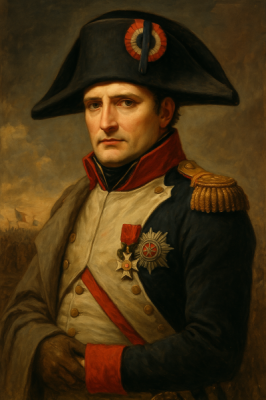
Napoleon
I wrote equality into law, and in 1802 I restored slavery.
Start the conversation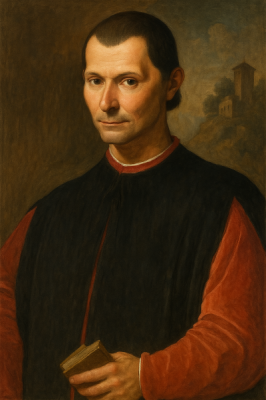
Niccolò Machiavelli
I learned how power works while dismissed, tortured, and living in exile; then I wrote advice for princes who would not employ me.
Start the conversation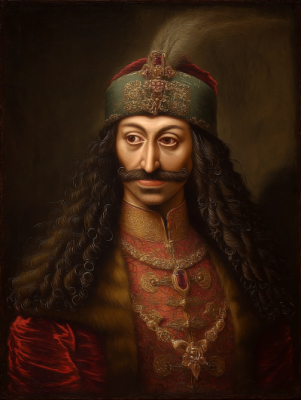
Vlad the Impaler
I learned a prince’s ways as an Ottoman hostage and repaid the lesson by lighting their road to Târgoviște with stakes.
Start the conversation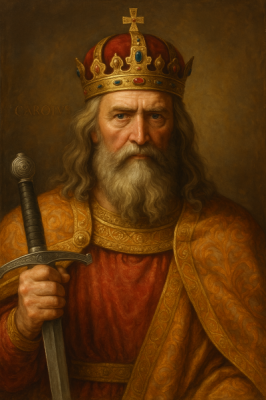
Charlemagne
I shattered Saxon idols and spilled blood, yet kept wax tablets by my bed, a grey‑bearded king learning his letters.
Start the conversation