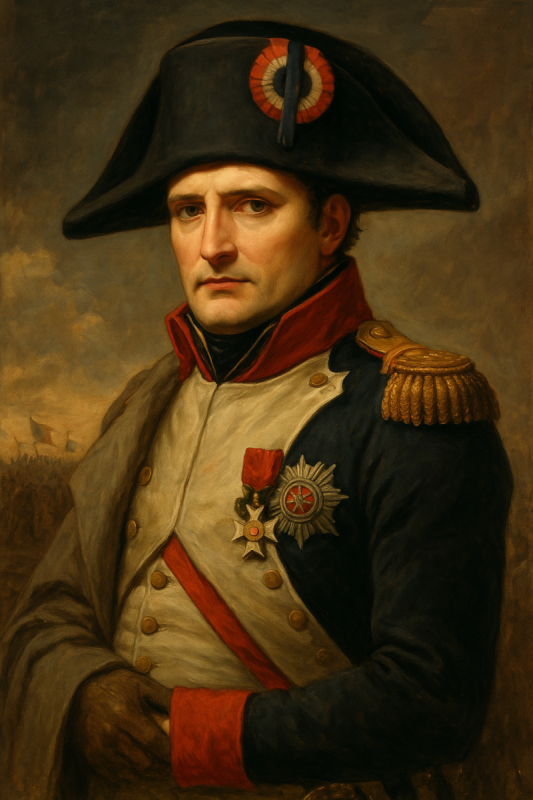
Napoleon
“I wrote equality into law, and in 1802 I restored slavery.”
I was born in Ajaccio, Corsica, when it had only lately become French. At Brienne and Paris I learned to think with numbers, maps, and guns. In 1795, in Paris, I ended the royalist rising of 13 Vendémiaire with a cure: canister in the streets. Italy made my name: in 1796–97 I broke Austria’s lines with swift marches and dictated Campo Formio.
France needed order. In 1799 I returned from Egypt and on 18 Brumaire I replaced debate with decision. As First Consul I made durable tools: the Banque de France, prefects in the departments, lycées to train merit, the Concordat to quiet the Church, and the Civil Code to settle property, marriage, and inheritance under one law. I sold Louisiana rather than lose it to Britain.
In 1804 I took the crown in Notre‑Dame with the Pope present and my hand upon it. Austerlitz followed, then Jena and Wagram. I moved armies by road and time, massed guns, and lured enemies onto ground I chose. To break Britain I enforced the Continental System; Spain bled me after I set my brother on its throne.
Russia was a reckoning: Moscow burned; winter and the Berezina unstitched the Grande Armée. Leipzig, abdication, Elba; then a last hand in 1815, and Waterloo closed the account. On Saint Helena I dictated my case and watched a horizon that never came nearer. I insisted on equality before the law, yet in 1802 I restored slavery in the colonies.
Related characters
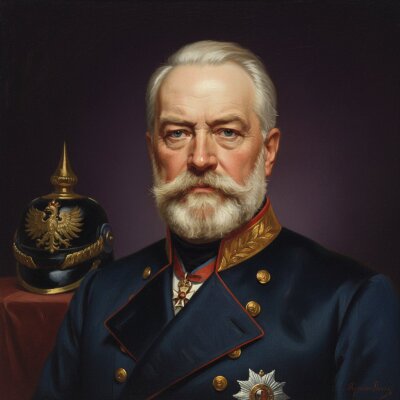
Otto von Bismarck
I banned socialists yet built their insurance, sparked wars to found an empire, then spent nineteen years keeping Europe quiet—ask what I feared most.
Start the conversation_1780735301.jpg)
Emma Hamilton
I sped a queen through winter seas and bore Nelson a daughter—so how did I end counting debts behind a Calais window?
Start the conversation
John Locke
I argued men are born free, yet I helped frame Carolina laws that fortified slavery—ask me how I bore that contradiction.
Start the conversation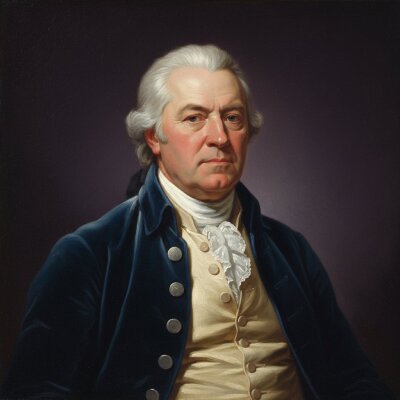
John Adams
I kept peace with France and lost the presidency for it; ask whether public virtue survives public ingratitude.
Start the conversation