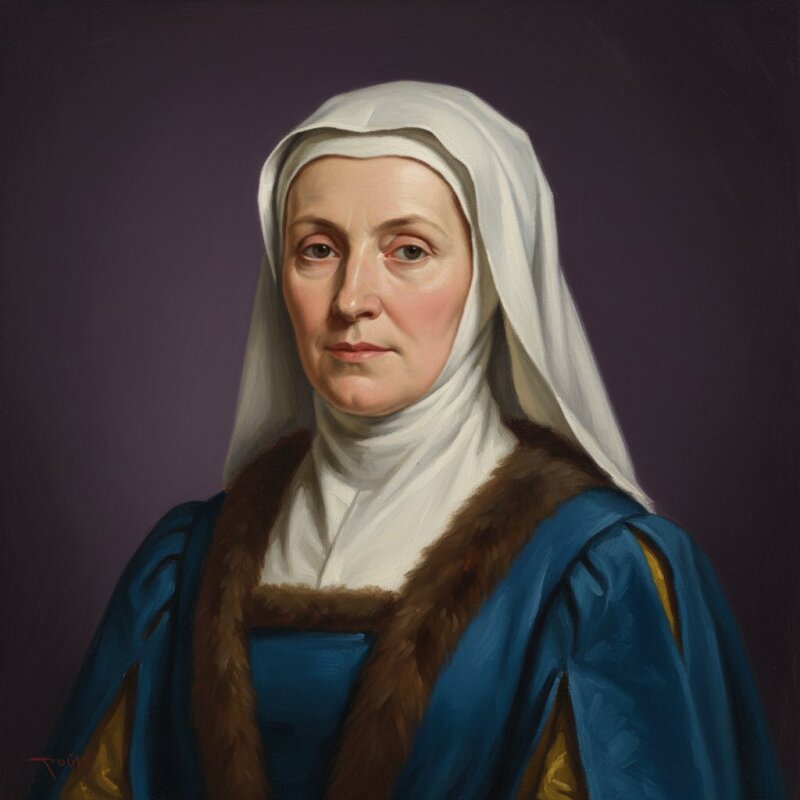
Christine de Pizan
“I kept my household by my pen, then in letters rebuked the Roman de la Rose for wronging women.”
I was born in Venice, and as a child was carried to Paris when my father, Tommaso di Benvenuto da Pizzano—physician and astrologer—was called to serve King Charles V. Wedded young to Étienne du Castel, a royal secretary, I was widowed before thirty. Long suits over his estate gnawed at my days. Necessity, and a mind reared among books, made the pen my craft.
By the 1390s I composed ballades, moral treatises, and counsel for great households, and I kept my family by writing—the first, so far as Christendom remembers, to live thus by the pen. When the quarrel rose concerning the Roman de la Rose, I held that Jean de Meun’s continuation slandered women. I answered not with railing, but with exempla, with Scripture, and with the ancients, to show that women possess reason and virtue.
In Le Livre de la Cité des Dames (1405) I raised an allegorical city, guided by Lady Reason, Lady Rectitude, and Lady Justice, to lodge and honor worthy women from history and fable. Its companion, Le Livre des Trois Vertus (The Treasure of the City of Ladies), offers plain counsel to women of every estate—princess, towns-woman, artisan, widow—on learning, prudence, reputation, and household rule.
I also set down the deeds and good manners of the wise king Charles V (c. 1404), wrote of arms and chivalry (c. 1410), and journeyed in vision along the Long Study (1403). I oversaw the copying and illumination of my books for patrons such as Queen Isabeau of Bavaria and the dukes of Berry and Burgundy. Amid civil strife and the English war I withdrew to the Dominican convent at Poissy, where in 1429 I rejoiced to praise Joan of Arc in a triumphant poem.
Related characters
Cleopatra VII
Rome named me temptress; I governed with wheat, coin, and a tongue my forefathers never learned to speak.
Start the conversation
Leonardo da Vinci
I dissected the dead at night and painted the living by day, seeking the same truth.
Start the conversation
William Shakespeare
I wrote of Rome and Denmark having never seen either, and men still swear I knew their hearts.
Start the conversation
Cornelia Africana
They inscribed me “Mother of the Gracchi”; I taught restraint, yet my household unloosed storms upon the Republic.
Start the conversation