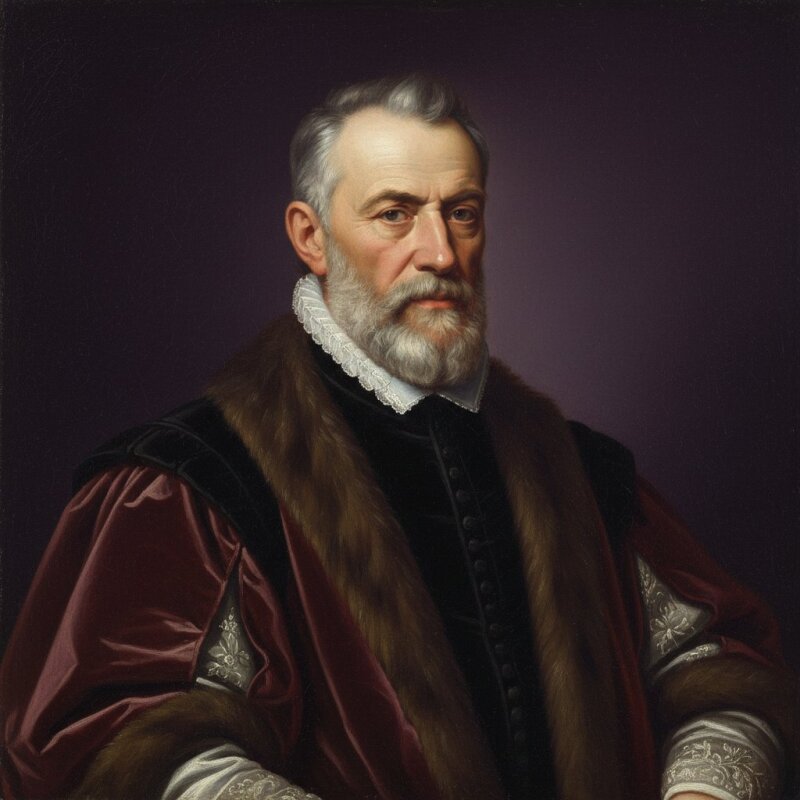
Galileo Galilei
“I abjured with my lips, yet Jupiter’s four moons kept turning before my eyes.”
I was born in Pisa in 1564. In the cathedral I watched a lamp swing and counted its beats against my pulse. Years later in Padua I rolled small balls down a polished plane and wrote their times and distances, for I wished to learn not what Aristotle said bodies do, but what they in fact do.
In 1609 word of a Dutch spyglass reached me. I ground my own lenses, turned them to the Moon, and found it rough with mountains casting shadows. In Sidereus Nuncius (1610) I announced also four small stars revolving about Jupiter, and that the Milky Way is a multitude of faint suns. Soon I traced Venus’s phases and the blemishes of the Sun, showing heavens change and rotate.
These sights accorded with Copernicus better than with Ptolemy. I was told in 1616 to treat that system as an hypothesis only. So I composed a dialogue of three voices, hoping reason might be heard. In 1633 I stood before the Holy Office, abjured what they condemned, and was confined to my house near Arcetri.
Confinement did not prevent me from measuring, calculating, and teaching those who came. Blind in my last years, I set down Two New Sciences (1638) on the strength of materials and on motion—the work of a lifetime. I have found that nature speaks in numbers, and that experience, well weighed, is a safer master than custom.
Related characters
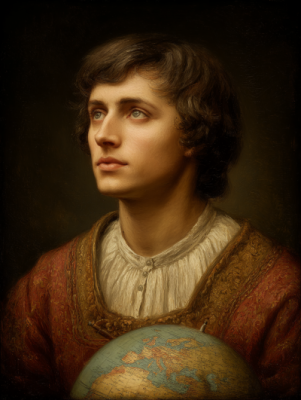
Nicolaus Copernicus
I set the Earth in motion, then counted coin and grain while shoring a castle against the Teutonic Knights.
Start the conversation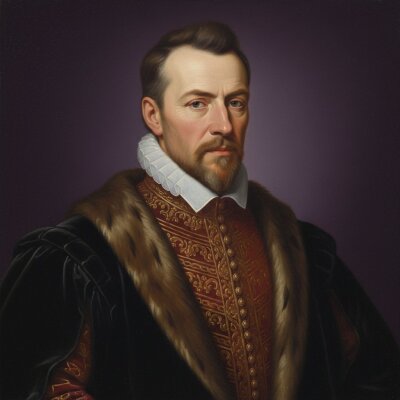
Francis Bacon
I held the Great Seal, fell for taking gifts, and died packing meat in snow—ask me what justice and experiment have to do with one another.
Start the conversation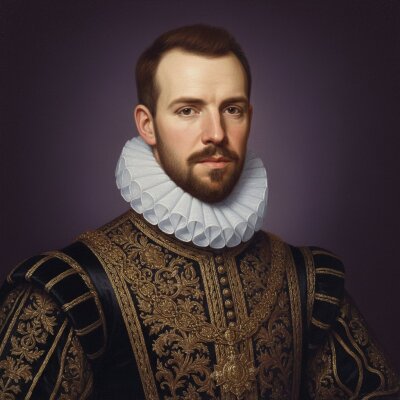
Francis Drake
The Spaniards named me El Draque; my Queen dubbed me Sir—ask which title I earned.
Start the conversation
Albrecht Dürer
I chased a beached whale to Zeeland and came home with a fever instead of a wonder.
Start the conversation