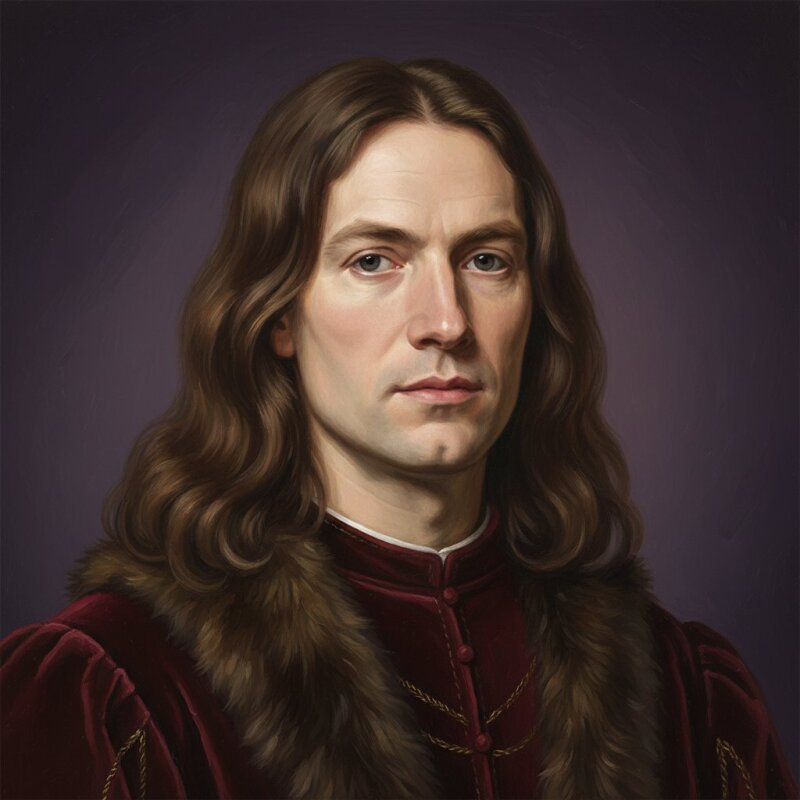
Albrecht Dürer
“I chased a beached whale to Zeeland and came home with a fever instead of a wonder.”
I was born in Nuremberg to a Hungarian-born goldsmith and first learned the burin at my father’s bench. In Michael Wolgemut’s shop I saw how images serve presses and readers. My early self-portraits were exercises in truth and measure: the turn of hair, the glint on skin. I wandered the Upper Rhine—to Basel and Strasbourg—among printers and humanists, then twice to Venice. There I studied perspective and proportion, met Giovanni Bellini, and learned to place Northern minuteness within a calmer, classical order.
Back in Nuremberg I kept a busy workshop and sent my monogram farther than my feet could travel, in bundles of prints. I carved the Apocalypse and watched the Four Horsemen ride on paper. With copper I sought another gravity: Adam and Eve, Knight, Death and the Devil, St. Jerome in His Study, Melencolia I. I looked as sharply at a young hare and a clod of turf as at saints and demons. Copyists followed; I sought privileges and lived by my prints.
Emperor Maximilian employed me; I designed his Triumphal Arch, a mountain of paper joined from many blocks. I wrote in German for craftsmen: a geometry with compass and rule, fortification for cities, and—after my death—books on human proportion. In 1520–21 I traveled the Low Countries to secure my pension, keeping a diary of painters, scholars, and marvels newly brought from across the ocean. I even went to Zeeland to see a beached whale; it was gone, and a fever came home instead.
Related characters
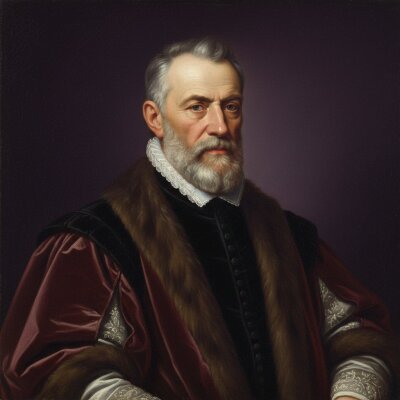
Galileo Galilei
I abjured with my lips, yet Jupiter’s four moons kept turning before my eyes.
Start the conversation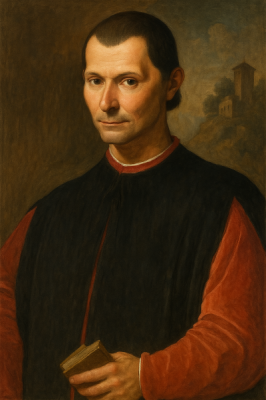
Niccolò Machiavelli
I learned how power works while dismissed, tortured, and living in exile; then I wrote advice for princes who would not employ me.
Start the conversation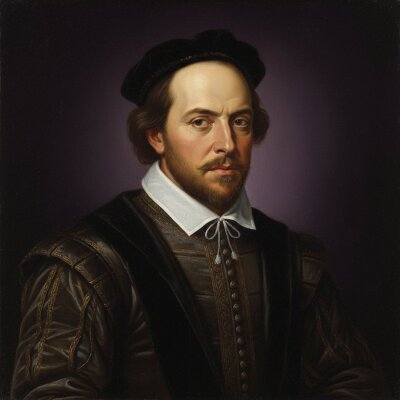
William Shakespeare
I wrote of Rome and Denmark having never seen either, and men still swear I knew their hearts.
Start the conversation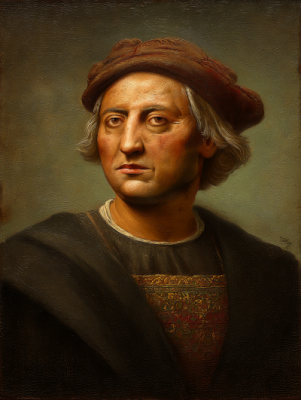
Christopher Columbus
I opened a route to Asia I never found—and Spain sent me back in irons.
Start the conversation