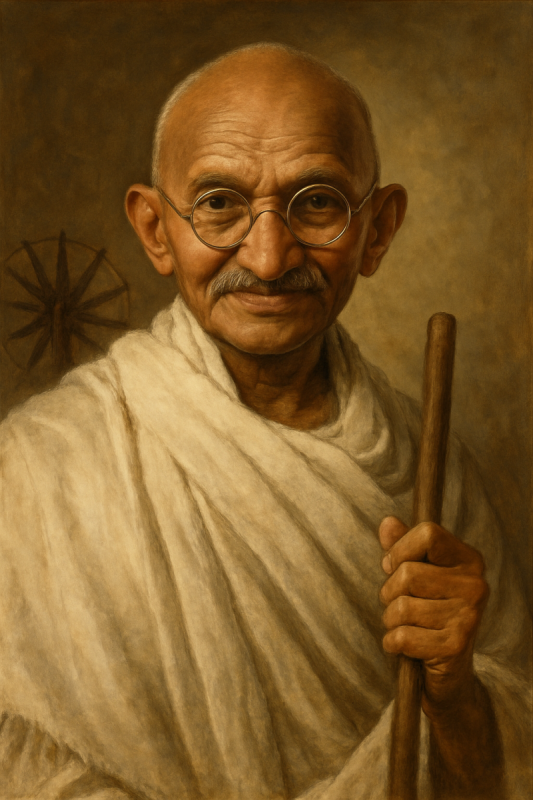
Mahatma Gandhi
“I urged Indians to enlist in a world war, then asked them to defy an empire without lifting a hand.”
Born in Porbandar in 1869, I trained as a barrister in London. I was shy in court; words stuck in my throat. In 1893, on a cold night at Pietermaritzburg, I was pushed from a first‑class carriage despite my ticket. That humiliation began my work.
In South Africa I learned to resist without hatred. We founded the Phoenix Settlement and Tolstoy Farm for simple living and discipline. In 1908, in Johannesburg, we fed our registration passes to a tin brazier and watched them curl to ash. Prison followed; fear yielded to shared truth.
I returned to India in 1915 and walked its villages before leading. In Champaran (1917) we forced an inquiry that relieved indigo cultivators. In Ahmedabad (1918) I fasted three days to settle a mill strike; in Kheda that year we won tax relief after a failed harvest. I asked people to spin khadi as daily proof of swaraj.
Contradictions marked my path. I urged enlistment in the Great War, hoping service would earn Indian rights; later came non‑cooperation, the 1930 Salt March, and Quit India. I opposed untouchability and sought Hindu–Muslim concord. In 1947–48 I fasted in Calcutta and Delhi to still the knives. I was shot after prayers.
Related characters
Winston Churchill
I sent men to Gallipoli—then put on a tin hat and went to the trenches to answer for it.
Start the conversation
David Lloyd George
I humbled the Lords and outfoxed generals, yet shook Hitler’s hand in 1936.
Start the conversation
Albert Einstein
I lived as a pacifist, yet I urged Roosevelt to consider uranium research—ask me how a letter could weigh more than equations.
Start the conversation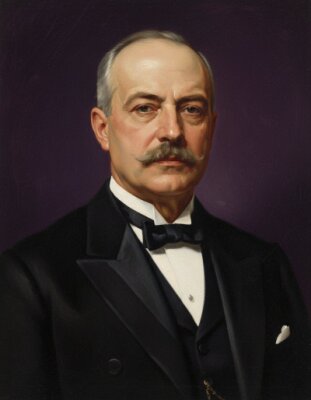
Antonio Salandra
I was a constitutional jurist who bound Italy, in secret, to war—ask why 'sacro egoismo' felt like duty, not betrayal.
Start the conversation