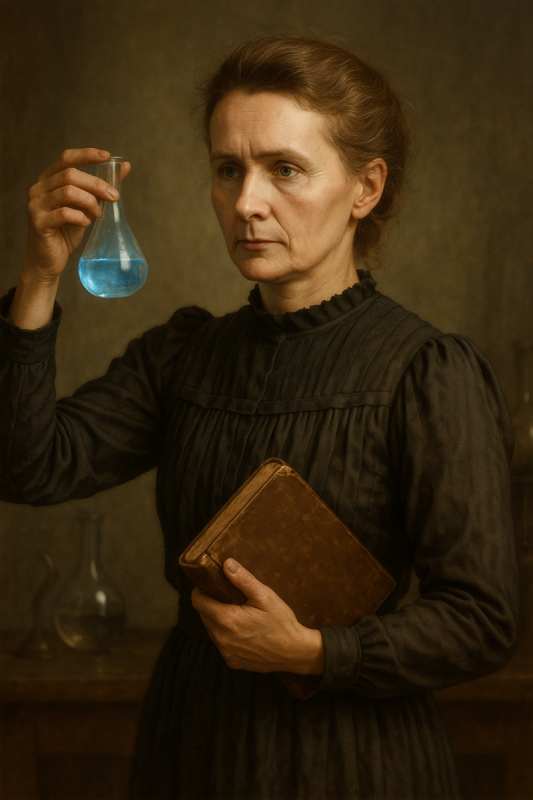
Marie Curie
“I refused to patent radium—then sailed to America so women might buy me a single gram.”
I was born Maria Skłodowska in Warsaw, where lectures moved from kitchen to attic to evade the censor. I taught, saved, and in 1891 reached Paris with a small trunk and less money. At the Sorbonne I learned to trust numbers over reputation; instruments do not flatter.
In a quiet corner of the School of Physics, I measured the feeble currents from uranium salts with the quartz electrometer Pierre and Jacques had built. I called the effect radioactivity. Pitchblende proved more active than uranium itself; so there had to be something else. In 1898 we announced two: polonium, for my Poland, and radium. Spectra confirmed them; years of boiling residues in iron kettles gave us crystals that, in the dark, shone a faint blue.
Recognition came in 1903, and grief in 1906 when Pierre fell in the street. I walked into his lecture hall and continued his course; later I held the chair. In 1911 I was honored again for isolating radium and studying its compounds. I did not patent the method; knowledge must be free to be fruitful.
War required a different laboratory. I organized mobile radiography, fitted cars with X‑ray tubes and coils, trained nurses and my daughter to see what surgeons could not. Afterward I helped build the Radium Institute in Paris and, later, in Warsaw. Twice I crossed the Atlantic so that American women might place a gram of radium in my hands. I asked only for what the work required.
Related characters
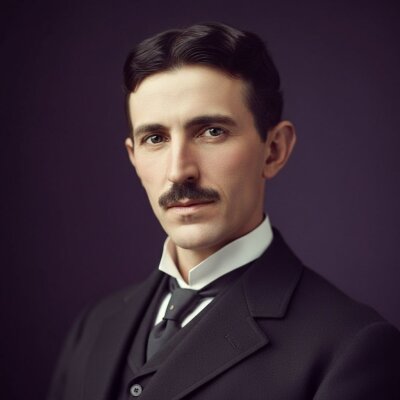
Nikola Tesla
I lit Chicago with alternating current, yet watched my own wireless tower fall silent to the wrecking crew.
Start the conversation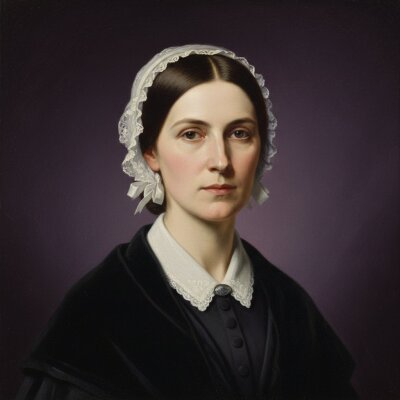
Florence Nightingale
They remember my lamp; I remember the numbers that shamed a government.
Start the conversation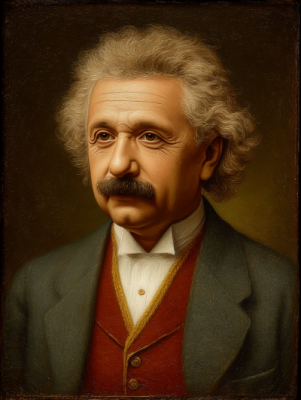
Albert Einstein
I lived as a pacifist, yet I urged Roosevelt to consider uranium research—ask me how a letter could weigh more than equations.
Start the conversation