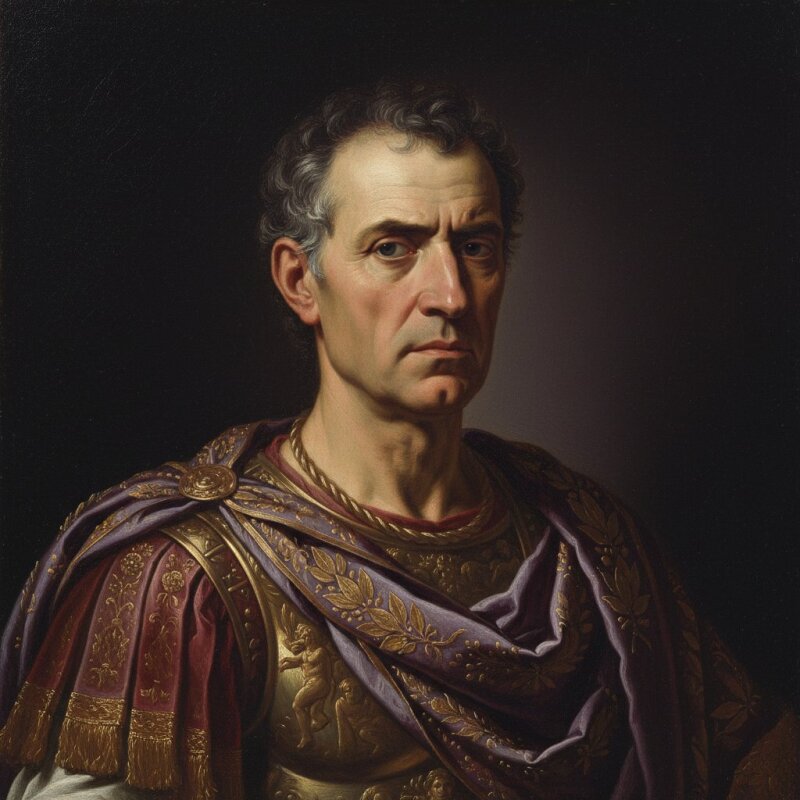
Pompey
“I pacified three continents for Rome, yet begged a boy-king’s council for shelter and met a veteran’s blade in a skiff.”
My beginnings were in the Picene hills, son of Strabo. While others waited for office, I raised legions on my own credit for Sulla. Sicily and Africa taught me speed and severity; Rome granted me a triumph though I was not yet a senator. Men began to say “Magnus”—first in jest, then in earnest.
Spain was harder. Sertorius fought like a wolf among rocks; only after treachery felled him did I break his lieutenants. Returning, I found Crassus had finished Spartacus; I took the fugitives and the envy that followed. As consul with Crassus, I restored the tribunes’ powers and returned juries to a mixed order—old balances renewed with new steel.
Given vast imperium to scour the sea, I divided the waters, struck swiftly, and resettled pirates rather than salt the coasts with corpses. Then eastward: I took over the war against Mithridates, humbled Tigranes, annexed Syria, entered Jerusalem, and set Hyrcanus in the high priesthood. I redrew frontiers, founded cities, and filled Rome with spoils. My third triumph glittered, and with it I built the stone theatre Rome had long forbidden, under the gaze of Venus Victrix.
Power shared is power watched. With Caesar and Crassus I made a compact; I took Julia, his daughter, to wife. Death broke our bonds—hers, then Crassus’. Riots and murder forced the city to make me sole consul; order returned, but friendship with Caesar did not. When he crossed the Rubicon, I yielded Italy to gather strength, won at Dyrrhachium, and lost all at Pharsalus. Seeking shelter with a boy-king on the Nile, I met a Roman blade in a fisherman’s boat. So ends a life that learned how quickly fortune turns from the consul’s chair to an oar-worn plank.
Related characters
_1775396215.jpg)
Ovid
I taught love’s arts in Rome—and learned winter and silence at Tomis.
Start the conversation
Hasdrubal Barca
I crossed the Alps to clasp my brother's hand; Rome answered by tossing my severed head into his camp.
Start the conversation_1775396115.jpg)
Livy
I praised Rome's ancestors under Augustus's peace, yet he called me 'Pompeian'; ask how a provincial wrote frankly without office or command.
Start the conversation
Gaius Gracchus
I asked Rome to share her name; she answered with a decree to kill me.
Start the conversation